

1936.10.4 FUTASHIROJIMA REPORT
DOC134-010-3557
THE FUTASHIROJIMA ANOMALY AND THE TENKEN MONJO: A STRATEGIC INTELLIGENCE ASSESSMENT
I. PREFATORY EXECUTIVE SUMMARY
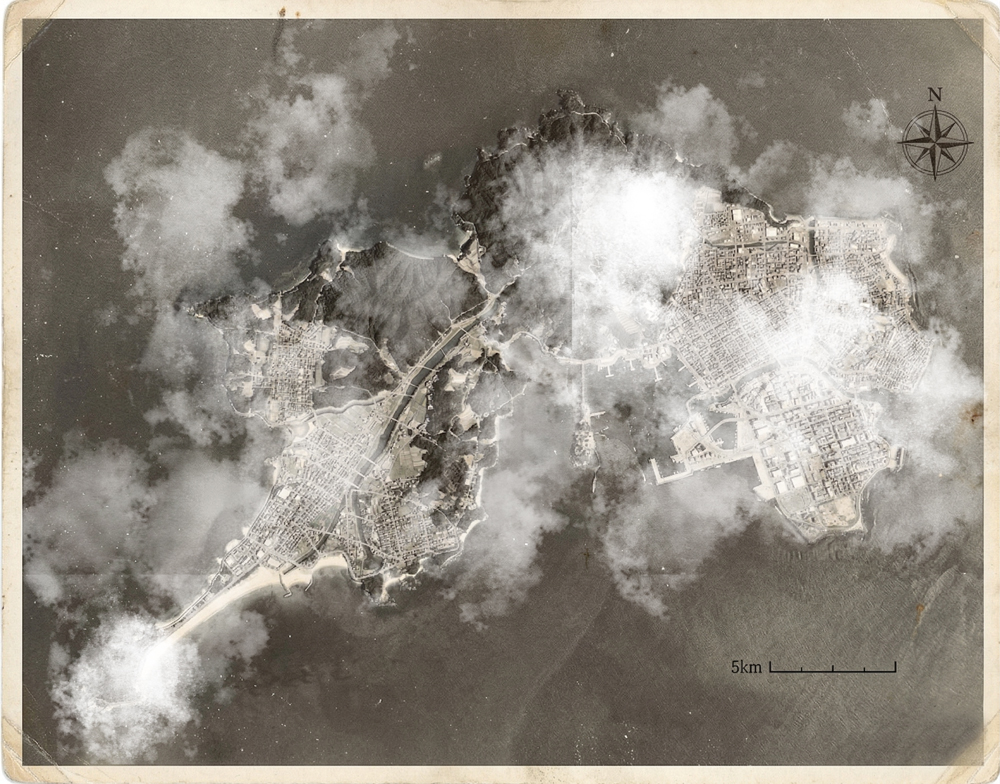
On October 4, 1936, a series of events within the Western Defense Command initiated what is now classified as the most significant intelligence discovery of the interwar period. During a standard loyalty and background investigation conducted by the Military Intelligence Division (MID) in coordination with the Office of Naval Intelligence (ONI), a Japanese national residing in California provided testimony regarding a geographically unmapped landmass designated as Futashirojima. While initial cartographic reviews suggested no such island existed at the coordinates provided (24 degrees 15 minutes North, 153 degrees 28 minutes East), a high-altitude reconnaissance flight subsequently captured photographic evidence of a concealed landmass.
The subject's testimony further revealed the existence of the Tenken Monjo (Tenken Documents), a set of ancient manuscripts allegedly containing advanced theoretical physics and blueprints for technologies that manipulate the fundamental structure of space and time. Intelligence gathered from naval attaches suggests that the Imperial Japanese Navy (IJN) has established a clandestine operation within its Special Research Bureau to recover these documents and integrate their findings into the Imperial Japanese military apparatus.
In response, the United States government has authorized the formulation of Operation Blue Note, a multi-agency strategic initiative designed to secure Futashirojima and its technological assets before they can be utilized to achieve Japanese hegemony in the Pacific. This report provides an analysis of the subject's testimony, technical verification, and the proposed tactical framework.
II. CIRCUMSTANCES OF DISCOVERY AND SUBJECT PROFILING
2.1. THE MID INTERROGATION OF OCTOBER 4, 1936 The discovery occurred at the Los Angeles field office of the MID during routine loyalty checks . The subject, a precision instrument mechanic with a background in physics, was required to complete a Personal History Statement . During the oral interview, when questioned about his place of birth, the subject referenced Futashirojima. When ONI attempted to cross-reference this with the Index Guide for Classification of Military Information, no record was found in the Geographic category. The subject maintained the island was known only to a specific lineage of navigators and the highest circles of the Imperial Japanese priesthood.
2.2. SUBJECT BIOGRAPHICAL DATA (PSEUDONYM: ISAMU) *Subject Identifier: Isamu (Placeholder pseudonym for classification) *Birthplace Claim: Futashirojima, Pacific Ocean *Education: Tokyo Imperial University (Physics Dept., withdrew 1925) *Occupation: Horologist and Optical Instrument Specialist *Surveillance Class: Priority 1 (Technical Information Suspect) *Loyalty Index: Ambiguous; cooperative but ideologically cryptic
The subject's technical background made his claims regarding unknown technologies particularly credible to the ONI. He described a repository of knowledge that bridged the gap between archaic mysticism and modern quantum theory.
2.3. TECHNICAL TERMINOLOGY: THE HEKIRAKU NO ITO PHENOMENON The subject utilized obscure terminology during debriefing, most notably a reference to Hekiraku no Ito, which he translated as Threads of the Celestial Void. He described Hekiraku no Ito as a specific ability or physical phenomenon used by the island's guardians to maintain its isolation. He suggested that this threading maintains the refractive shield surrounding Futashirojima. The ONI views this as a potential reference to electromagnetic or temporal filaments manipulated by unknown means.
III. CARTOGRAPHIC DISCREPANCIES AND RECONNAISSANCE
3.1. PRE-MISSION CHART ANALYSIS *U.S. Hydrographic Office (H.O. 526): Recorded as Unbroken Ocean at 2,900 fathoms. *British Admiralty (BA 2683): Recorded as Open Sea. *IJN Hydrographic Dept. (No. 102): Marked as Geomagnetic Anomaly Zone (Restricted).
The Japanese chart No. 102 was of interest, as it marked the area as a zone of unreliable navigation due to atmospheric and magnetic disturbances rather than open water. This correlated with the subject's claim that Futashirojima was shielded from uninitiated navigators.
3.2. RECONNAISSANCE FLIGHT LOG: OPERATION MIRAGE On October 12, 1936, a Douglas Dolphin aircraft modified for meteorological survey reached the target coordinates. The crew reported nothing but a featureless sea visually. However, a Signal Corps photographer captured a continuous record using a Fairchild K-17 aerial camera, which is sensitive to a broader light spectrum than the human eye.
3.3. AERIAL PHOTOGRAPHY ANOMALY REPORT *Roll OM-003 (Frames 201-300): Positive (Frame 234). Frame 234 revealed a startling contradiction to visual reports, showing a faint mountainous silhouette rising approximately 1,500 feet above sea level.
IV. ANALYSIS OF THE CLOAKING HYPOTHESIS
4.1. THE PHOTOGRAPHIC EVIDENCE Densitometric analysis suggests Futashirojima was obscured by a superior mirage effect, or Fata Morgana. This occurs when a cold air layer is trapped beneath a warm air layer, causing light rays to bend downward following the Earth's curvature.
4.2. OPTICAL CLOAKING AND REFRACTIVE INDEX Technical consultants propose Futashirojima may be within a permanent thermal inversion layer, creating an optical duct. In such a zone, the refractive index varies with altitude in a manner that causes light rays to curve more than the Earth's radius, rendering the island invisible to sea-level observers.
V. THE TENKEN MONJO: TECHNOLOGICAL ANALYSIS
The subject described the Tenken Monjo as a synthesis of the past, present, and future. *Causal Analysis: A method for predicting events by analyzing the tension between different layers of time described in the manuscripts. *Anomalous Energy: A source derived from the void. The subject hinted at a propulsion system manipulating the gravitational constant via unknown principles.
Mathematical principles found in the subject's testimony suggest energy fields not found in standard Maxwellian electrodynamics.
VI. OPERATION BLUE NOTE: THE STRATEGIC RESPONSE
Operation Blue Note is a multi-stage plan to secure the Tenken Monjo. *Phase I (1936-1937): Developing sensors to neutralize refractive anomalies. *Phase II (1937-1939): Covert surveillance and site mapping via submarine deployment. *Phase III (1939-1941): Document extraction via specialized Marine landing. *Phase IV (1941+): Data recovery and denial.
VII. INTERNAL SECURITY AND THE CASE OF ISAMU
The evidence provided by the subject, corroborated by Roll OM-003, confirms Futashirojima and the Tenken Monjo are a reality.
1.Immediate launch of Operation Blue Note Phase II. 2.Full mobilization of a physics task force to analyze the Hekiraku no Ito phenomenon. 3.Expansion of surveillance on any hereditary knowledge within the Japanese American community regarding the island.
The Pacific must not become a Japanese fortress through the mastery of these unknown threads.
Respectfully submitted,
Captain William D. Puleston Director of Naval Intelligence
Colonel Sherman Miles Military Intelligence Division
Cordell Hull Secretary of State (Advisory Capacity)
[日本語訳] 蓋代島アノマリーと天譴文書:戦略的インテリジェンス評価報告書
I. 序文:要旨 1936年10月4日、西部防衛司令部内で発生した一連の出来事は、現在、戦間期における最も重大な諜報上の発見として分類されています。 軍情報部(MID)と海軍情報局(ONI)による日系人の忠誠心調査において、カリフォルニア在住の日本人が、地図に記載されていない「蓋代島(ふたしろじま)」について証言しました。初期調査では島の存在を確認できませんでしたが、その後の偵察飛行により、隠蔽された陸地の撮影に成功しました。対象者の証言によれば、この世の成り立ちや未知の技術が記された「天譴文書(てんけんもんじょ)」が存在します。
情報によれば、日本海軍は「特別調査局」内に秘密部門を設立し、これらの文書の回収と技術統合を進めていることが示唆されています。 これを受け、合衆国政府は、日本が太平洋の覇権を握る前にこれらの資産を確保する戦略的イニシアチブ「ブルーノート作戦」を承認しました。
II. 発見の経緯と対象者のプロファイリング
2.1. 1936年10月4日の尋問 最初の発見はロサンゼルスのMID事務所で発生しました。対象者は、東京帝国大学で物理学を学んだ精密機器工の「Isamu(機密保持用の仮名)」と特定されました。 出生地を問われた彼は、繰り返し「蓋代島」に言及しました。軍の地理インデックスに該当はなく、彼はこの島が特定の航海士の家系と神道の最高位層にのみ知られていると主張しました。
2.2. 対象者の略歴 ・識別名:Isamu(仮名) ・出生地:太平洋、蓋代島 ・教育歴:東京帝国大学(物理学科、1925年中退) ・入国:1926年、サンペドロ経由 ・職業:時計師、光学機器専門家
彼の技術的背景は、その主張に高い信憑性を与えました。彼は古代の神秘主義と現代物理学を繋ぐ知識体系について説明しました。
2.3. 技術用語:「碧落糸(へきらくのいと)」現象 詳細な聴取において、彼は「碧落糸(へきらくのいと)」という特殊な用語を一回だけ使用しました。 彼の説明では、これは島の守護者たちが隔離状態を維持するために用いる特定の能力、または物理現象を指します。この「糸」が蓋代島を囲む屈折シールドを維持していることを示唆しており、ONIはこれを未知の手段で操作される電磁的・時間的なフィラメント(細糸)であると見ています。
III. 地図上の矛盾と偵察
3.1. 海図分析 ・日本海軍水路部 (No. 102):この海域を「地磁気異常地帯」および「航海不能地帯」としてマーク。
これは、島が「未熟な」航海士から遮蔽されているという彼の主張と一致します。
3.2. 偵察飛行:ミラージュ作戦 1936年10月12日、目標座標に到達した偵察機は目視で「特徴のない海」を報告しましたが、航空カメラには驚くべき矛盾が写っていました。
3.3. 航空写真分析 ・ロール OM-003:高高度の靄の中に山影を確認(フレーム234)。
IV. 隠蔽仮説の分析
4.1. 蓋代島の証拠 フレーム234には海抜約1,500フィートの山影が写っています。分析の結果、島は「上位蜃気楼(ファタ・モルガーナ)」効果によって隠蔽されていたことが示唆されました。
4.2. 光学迷彩技術 顧問は、島が恒久的な温度逆転層(光学ダクト)の中に位置していると推測しています。これにより光線が曲がり、海面からは島が水平線の下に沈んで見えることになります。
V. 天譴文書:技術的分析
5.1. 分析の枠組み ・因果の編み込み:時間の層の間の「張力」を分析し、未来を予測する方法。 ・変則的エネルギー:碧落の糸の原理を用い、重力定数「G」を操作する推進システムの可能性。
5.2. 日本海軍の動向 ・特別調査局 第7課:文書回収を担当。 ・S-7 実験部門:屈折遮蔽の研究を担当。
日本がこの技術を手にすれば、米海軍の優位性は、完全に視認不可能な軍事力によって無効化されるでしょう。
VI. ブルーノート作戦 フェーズI:屈折を無効化するセンサーの開発。 フェーズII:潜水艦による監視とマッピング。 フェーズIII:特殊海兵部隊による蓋代島上陸と文書抽出。
VII. 物理学的分析 島は「不安定な居住」状態にあり、高次元で振動していることが示唆されています。碧落の糸の原理を操作することで、これらの時空変数を人工的に調整することが可能であるとされています。
VIII. 国内治安 Isamuは現在も保護拘置されています。彼は「文書は盗むことはできず、理解することしかできない」と警告し、碧落の糸の効果は観察に敏感であるため視認接触が困難であると語っています。
IX. 結論および推奨事項 証拠により、蓋代島と天譴文書の実在が確認されました。 1.ブルーノート作戦フェーズIIの即時開始。 2.「碧落の糸」現象を分析するタスクフォースの動員。 3.島に関する知識を持つ日系人コミュニティへの監視拡大。
太平洋を日本の要塞にしてはなりません。
謹んで提出いたします。
海軍情報局長 ウィリアム・D・プレストン大佐 軍情報部 シャーマン・マイルズ大佐 国務長官(諮問) コーデル・ハル